




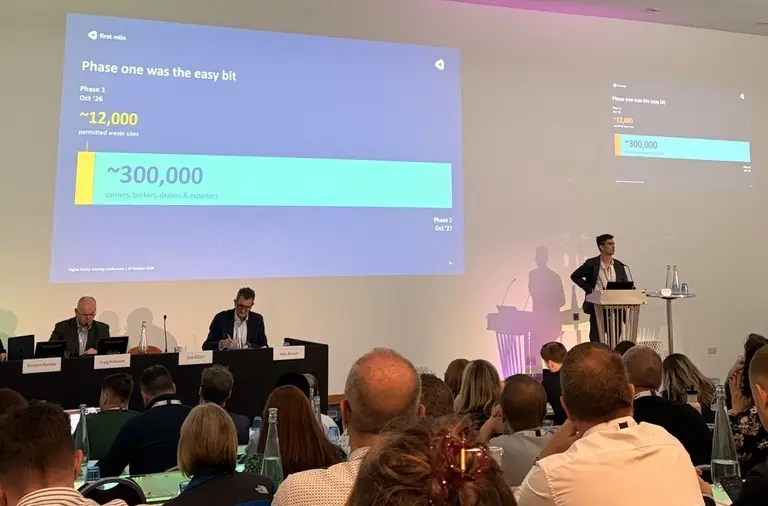
On Tuesday 20 October 2026, First Mile exhibited at the Digital Waste Tracking Conference, organised by letsrecycle.com. First Mile Chief Commercial Officer, Joe Allen, spoke during session three, Technology and Opportunities, discussing what it takes to put digital waste tracking into practice across our operations.
For any business that produces commercial waste, this conference addressed an essential shift from paper records to a centralised digital waste tracking. The changes directly impact your legal compliance, corporate sustainability reporting, and the daily audit trail of every bin leaving your business.
Watch the full talk
Joe’s presentation at the conference covered both customer and operator perspectives. The sections below focus on what digital waste tracking means for you as a waste producer and includes practical lessons we learned rolling out our own systems.
Where digital waste tracking is now
The UK waste sector is facing its most significant regulatory update in decades. Under Defra's roadmap, mandatory digital waste tracking will replace paper waste transfer notes with central digital records.
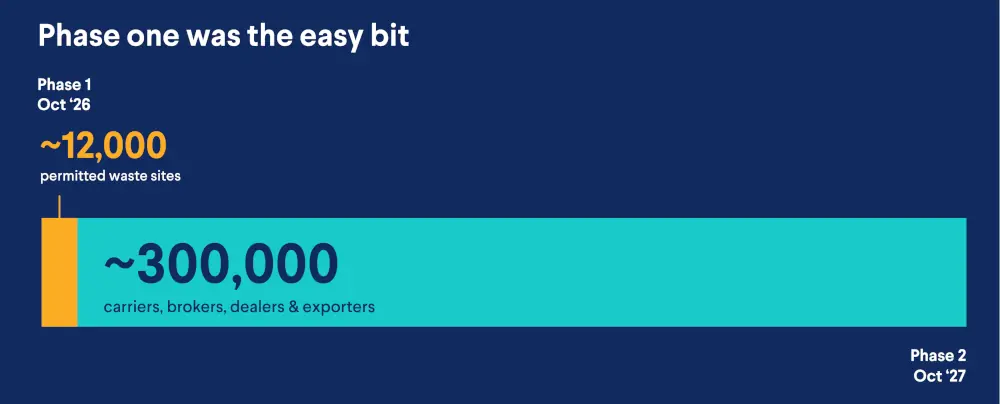
The scale of this transition is vast. Across the UK, there are roughly 12,000 permitted waste sites that were impacted in Phase 1, however there are 25x more businesses to come into scope in Phase 2. Around 300,000 registered carriers, brokers, and dealers will need to replace paper waste transfer notes with digital waste tracking from 1st October 2027.
Industry readiness remains surprisingly low. Before speaking, Joe chatted with an industry software provider who told us that businesses approaching him were, on average, a resounding one out of ten ready. Many businesses are still working out their first steps in digital waste tracking. However, meeting compliance does not need to be complicated once you focus on the fundamentals.
What it means for you as a customer
The most common reaction we hear from businesses is: "We only produce the waste. Our collector will handle digital waste tracking, so it does not affect us".
It is true that the legal duty to upload collection records to Defra rests primarily with licensed waste carriers and permitted facilities. However, there is an important caveat that concerns waste producers.
As Joe highlighted in his talk, First Mile and other operators will be publishing data directly to Defra that features your business name, your site addresses, and the specific waste streams coming out of your premises. Even if the regulatory upload mechanism sits with your waste provider, it is your business data that populates the public record.
If a provider submits inaccurate data or misclassifies materials, that record sits permanently in a government database under your name. Sustainability managers, facilities leads, and compliance teams will want to ensure that what appears in Defra's system reflects their true environmental performance. Transparent waste reporting under digital tracking will become central to corporate governance.
To stay compliant and confident, businesses should focus on three practical areas:
-
Know exactly what is inside your bins: Digital waste tracking requires precise classification using European Waste Catalogue (EWC) codes. An EWC code is a standardised six digit number used across the UK to classify specific waste types, such as 15 01 01 for paper and cardboard or 15 01 02 for plastic packaging. Contaminated recycling bins or mislabelled hazardous items will now be documented in central records under your business profile.
-
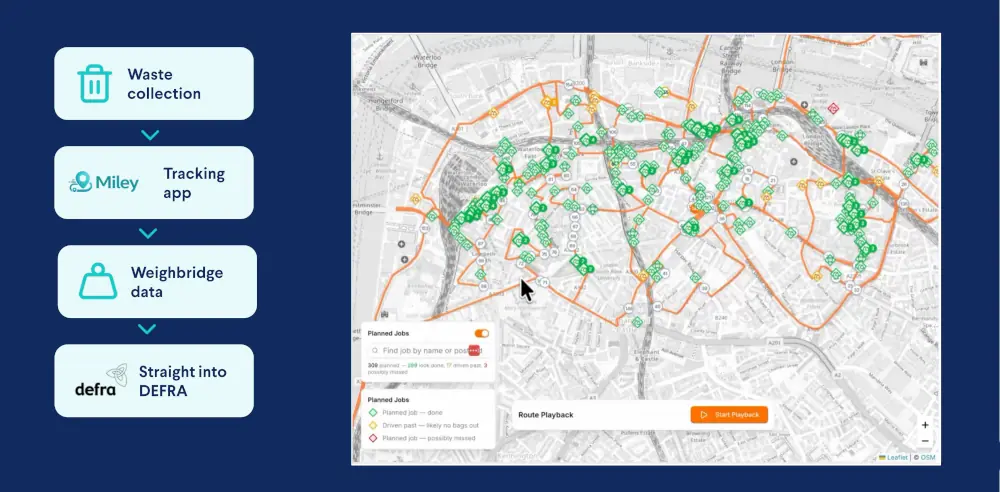
Check your provider's reporting standards: Ask your waste collectors how they record your collections. Are they relying on rough paper estimates, or do they have verified digital systems? At First Mile, our vehicles link directly to our tracking platform, Miley, and weighbridges. We use geostamping, which pins your transfer note to an exact geographical boundary. If we collect cardboard from your loading bay, that collection is geocoded, giving you clear verification that your collection took place at the right address.
-
Audit your internal data now: Whether you manage a single shop or multiple commercial properties, clean waste records protect your business during audits and ESG reporting. We have published guidance on digital waste tracking for SMEs to help businesses of any size set up straightforward waste inventories.
What we learned putting it into practice
For waste operators, building a digital tracking process can look like an intimidating project. When we began our journey at First Mile, our starting point was build, not buy. We decided to extend Miley, our bespoke waste tracking software, rather than purchase a generic third party system.
Whether an operator chooses to build or buy, our main learning remains identical: the tech was not our stumbling block; it was making sure we had accessible data.
Software providers offer platforms packed with features. However, no software can fix disordered data. We began from a simple starting point: a CSV spreadsheet listing Defra's required data fields. Our steering committee mapped where each data point lived in our existing systems before touching any software code. That basic mapping gave us our fastest progress.
We also engaged directly with regulators. We joined the Defra beta programme early and kept in regular contact with their technical team. Defra proved very responsive, which helped us adapt our weighbridge logging, vehicle registration tracking, and EWC classification feeds to match regulatory standards.
Finally, internal culture matters just as much as technology. You cannot treat compliance as an isolated project. Over the past year, we ran 30 internal updates during our weekly town halls, supported by detailed training and process updates. We also hosted 15 seminars with our customers. This ensured our account managers, customer service staff and drivers understood the regulations thoroughly, creating widespread confidence across our business.
What's next
Digital waste tracking is rolling out in distinct phases, and phase one is only the beginning. To discover how upcoming reforms will influence carrier licensing, consignment notes, and commercial collections, read our guide on what comes after phase one.
Our team is also continuing to lead industry discussions this quarter. On 3rd November 2026, First Mile Chief Executive Officer Susan Davy will speak at the National Waste Crime Conference. Susan will examine how waste operators and customers can work together to prevent waste crime, eliminate rogue operators, and uphold high standards across the industry.
What is digital waste tracking?
Digital waste tracking is a UK government initiative led by Defra and environmental regulators across England, Scotland, Wales, and Northern Ireland. It replaces paper Waste Transfer Notes with an online service that records commercial waste movements, improving transparency and tackling waste crime.
Does digital waste tracking affect waste producers as well as waste carriers?
Yes. While waste carriers and permitted site operators upload data to Defra, the submitted information includes your company name, collection address, and waste volumes. Waste producers retain a legal Duty of Care to ensure their waste is correctly classified and collected by authorised providers.
What is an EWC code and why do I need to know mine?
An EWC code (European Waste Catalogue code) is a standard six digit classification number used to identify specific waste materials. Every commercial collection must be classified with an EWC code to ensure it is handled lawfully and directed to suitable recycling or recovery facilities.
Will digital tracking replace paper Waste Transfer Notes completely?
Yes. Digital waste tracking is designed to phase out paper Waste Transfer Notes (WTN) and static annual season tickets entirely. All transfers will be logged electronically, creating an instant and searchable digital audit trail. Currently only waste receivers are covered, the transition from paper WTNs to digital tracking will be complete once phase 2 is live in October 2027.
How does First Mile record customer collections digitally?
First Mile logs collection data across every operational step. Our drivers use mobile applications connected directly to our weighbridge facilities, and we apply geostamping to confirm that collections happen at your exact premises.
What should my business do now to prepare for digital waste tracking?
Start by auditing your waste streams to ensure your recycling and general waste are correctly sorted and matched to the right EWC codes. Then check with your waste provider to confirm that their digital systems are ready to supply compliant reporting for your sites.

